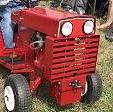
| |
-
WOW.! That's a good start Chris. Shouldn't have much trouble identifying it now with a clue like that.
-
Another item found weeks ago while clearing John's barn. We have picked it up, puzzled over it, scratched our heads and put it down again numerous times.
Someone will hopefully have an answer. 8" long and the only marking is No 2 on the handle. As can be seen on the photo's, I hope, sliding the central bar forward opens out the end of the side arms slightly which are closed again via the spring when the bar is retracted. Hope this is clear.
-
There are times when John looks upset at seeing his years of collecting being disposed of Richard, but he also appears resigned to it. As you and others probably know his aim when he retired 11 years ago was to spend time in his workshop and bring some of his machinery back to life.
The first few years were spent rebuilding parts of his house, still unfinished, then other things got in the way, the main one being his illness which has progressed rapidly over the last three years. I have known him for about 45 years and it is sad to see him like this.
-
-
Yes, it is a shame Paul. Had planned to use it and play on John's land, plus also hoped to take it to shows. But as said, once John has sold up I don't have room at home for it or a trailer to get it around.
The plan now is a 1/2 size semi scale tractor which should fit into my Meriva. Just about big enough to sit on. This is partly built, ( slow job due to helping John ), using mainly bits from the Showman's favourite hunting ground and will be known as LITTLE HORSE. We have a Black horse, a Trac horse and a Shakin horse and maybe others so why not a Little Horse.
-
-
-
Also missing, what a surprise, was the belt guard and it's mounting bracket. I estimated the size and shape from photo's and made one up from alloy sheet and a cat food bowl. Not an exact copy but better than the nothing that was there before.
The slotted plate, which fits just behind the guard was also made from alloy.
Lots of other small parts were either bought or made including the steering wheel center. Most where not recorded or had photo's taken. The decals were made by my son. Difficult to know what exactly was originally fitted as various photo's showed different arrangements so a guess was made.
-
-
If he's not at home Norm, he'll be at John's.
-
Did the same a few weeks ago. Narrow country road, dark, raining and about 18 miles from home. Almighty bang. Had a quick look but couldn't see much in the dark. Car felt OK so carried on. Found a large dent the next day, probably twice as bad as yours Mark. Had lost a bit of air overnight.
Not sure if it was a pothole or something on the road but the closely fitting wheel trim, which sits hard against the rim, was undamaged. The tire LOOKED OK too. Car has a spare wheel, now fitted. Still need to have the tire checked and it, or a new one fitted to a rim bought from a breakers.
-
Paul, your shed / s must be like the Tardis. I seem to remember when you bought John's Cub a few months ago, you said you might JUST have room for it. How many since then and how many more can you squeeze in. ?
-
Looks foggy in your yard Chris. Or is it from smouldering wood caused by your high speed sawing.
-
A few bits and piece's this time. As previously said the tow bar / plate was damaged and cracked. Could have been welded up but a new tow bar was made along with a smaller one for the front of the tractor. These were bolted on.
The fuel tank retaining bracket was another missing part. A new one was made up from plate with rubber buffers. Copied as near as possible from photo's.
Five of the ten wheel bolts were missing. Again nothing found this side of the pond, and a silly price at the other side. Plenty of 7/16th unf but nothing UNC. If there was I couldn't find any. The heads of standard 7/16th bolts were too thin to machine a cone so these were modified by drilling and tapping old 3/8 unf wheel nuts, from John's place, then fixed to the bolt using lock tight then pinning with dowels. The heads then filed down to match the surviving originals. Would have been quicker to weld, but that's the way I went.
Even the seat bracket had been welded up.
The seat was in very poor condition. The pan could have been welded up but the padding was too far gone. A Honda seat was obtained from one of John's friends and a modified mounting made up. No close up photo's of this.
The last photo's for now are of the wings and fuel tank.
-
-
The engine, when the tin covers were removed, looked a mess. Corrosion and rust everywhere. The outlet of the exhaust box non existent and the internal baffles rattling around.
As it appeared to run OK it was decided to just do the minimum to it for now. All the parts which were easily removable, without disturbing too much, were unbolted, cleaned and painted. The corrosion was cleaned from the cylinder heads and crankcase mainly with various size wire brushes. A long and laborious job. The next photo's show the engine during cleaning with some of the bits still to be removed.
The exhaust was a big problem. Couldn't find a replacement anywhere for a long time. Then one came up on eBay, listed by a MoM member. The box looked the same but both pipes were of different shapes, length's and distance apart. It was thought this was an almost new unit and had been removed from a different version of the Briggs flat twin. No photo's of the box as it was. The box fitted the mounting bracket perfectly and was the same size as the old, but there was no easy way to connect the pipes to the stubs on the cylinders even using flexible pipe and various other ways I tried.
After much head scratching and splinter picking I wondered if I could use the pipes from the old exhaust, which were in fair condition, fitted to the new box. These were cut from the box leaving the internal part of the pipe attached. The pipes were cut from the new box and with a bit of fiddling the old pipes were made to slide in. Another lucky find in my junk pile were parts of a tent frame, or something similar. The stepped plug in ends were found to be a perfect fit to repair the rusted ends of the old pipes where they fitted over the cylinder stubs. Hope this all makes sense. Anyway, more photo's which should hopefully make things clear.
After all the bits were ready and fitted to the engine they were tack welded together, by a mate who is miles better at welding than I am, then removed and fully welded up. A quick coat of paint finished the job.
-
That looks a fairly simple repair Paul. At least there is something to repair. I had nothing to work with on the lower half of the Roper grill.
-
Thought you would have painted the edges RED Chris.
-
Thanks Ian. Glad you like.
Should have said that before painting, odd gaps in the wood were filled and then the lot sealed with resin which will hopefully keep any damp at bay. The metal hood had various ripples, especially at the front end where it was bolted to the plastic grill. I got most of these out and a bit of filler helped. Not perfect but miles better than it was. A few of the fixing studs had broken loose from the plastic. These were re fixed with Araldite. A small sheet of diamond metal gauze from B & Q was JUST enough with careful cutting to complete the grill along with a pair of lamps from eBay.
In hindsight, I could have made the grill from plastic. Next time maybe.
When the lower grill was made the engine was not mounted so measurements were taken from the front mounting holes, engine and chassis, the front and underside of the cylinder head cowling etc to make sure that there was clearance. All well and good, until later.
A replacement grill mounting bracket was made, constantly checking for correct positioning, height and did it look right on the dash. Yes, it did. Jumping ahead a little, the engine was bolted in, the cyl head cowlings fitted, still good. Until I went to fit the engine side cowling. No clearance between the front of this and the side plate of the lower grill.
Bother and other such naughty words. No only was there no clearance but the grill / hood assembly needed to be moved forward by about 3/4". Couldn't work out why at first then the penny dropped. My previous measurements had overlooked that the grill side plate was set back and to the side of the engine cyl cowling. Hope this makes sense.
So off came the grill and hood again. The grill was moved forward on the mount and things started looking good again. Even though there was 3/4" difference the hood catches still engaged and a bit more of the dash top showing wasn't too obvious.
It was quite a while after this that I found the reason for my mistake. All the photos I had used for reference etc were of tractors fitted with Kohler or Onan engines. I finally came across a photo showing one with a Briggs engine and could see that the left lower grill side plate was NARROWER than the right. The side cowling on the Briggs has almost square corners, the others rounded ends so no need for a shorter end plate. At least that's my reckoning. Probably why the eBay sellers were unsure if their grills would fit.
This last photo, from a US forum, shows an Onan engine with the more rounded cowling.
-
Now, what to do about the grill assembly, especially the non existent lower section. A few popped up in the US, top and bottom units but all were listed for SS16 tractors. Again most with various damage and high cost with the usual lottery win postage problem.
I did contact two sellers asking if the lower SS16 section would fit a GT16. After supplying engine number and other details the reply from both was "Can't be certain". At the time I couldn't see why as both the SS16 and GT16 grills looked similar on various photo's. I wondered if there was a difference with the mounting bolt or hinge pivot positions, neither of which would have mattered due to the non existence of either on my tractor. I now have a good idea why both sellers were unsure, more of this later in the build.
So, what now. After studying lots of photo's, both of complete tractors and upper and lower grill sections, it was decided to make my own lower half and repair the damaged top section.
Working from a good dead on side view photo found on a US forum and from my damaged top section, I was able to work out the size, width, height, depth and angle of the side panels etc of the lower section. Not to the nearest thou, but close enough to compare with the photo's.
Could I make a pattern and mould one in glass fiber as I had done with model boat hulls.? Too much bother compared with a boat hull so that idea was thrown out. If I was to make a pattern why not use the pattern as the finished article. So that's the way I went. Mainly softwood and birch ply glued and screwed together.
I started off by repairing the hinge mounting bar of the top grill section bolted and bonded onto the remains of the original. There was just enough left at each end which also gave the correct angle for the new wood mount. Seen in the first photo with the roughed out lower section.
The following photo's show various stages of the lower section build. This seemed to take forever with constant checking both on and off the chassis, including cutting out approx 1/2" from the center of the base as the side panels were not quite at the correct angle.
The next few photo's are of the almost finished assembly with modified cabinet hinges. These "Might be useful one day" hinges were cut to suit, re drilled and had the fixed pins reduced slightly in diameter so that they could be removed enabling the top section to be lifted off leaving the lower attached to the chassis. Similar to the original units. As said, it took ages getting things to look like the original. Constant assembly and dis assembly, especially with the hinges to get the gap correct between both sections. There are also various angles on the lower section inner faces, not easily seen on the photos. These were determined from the angles of the top section.
More to follow. I'm out of breath from all this talking.
-
I like fiddly bits Mark. Not quite mechanical but some details of a four foot radio controlled battleship I made some years ago. All scratch build. The hand rails are 10mm high which will give an idea of the size. Eyes not so good now so might be difficult to repeat.
-
Lots of small boring jobs done then it was decided to tackle the badly damaged dash tower. Nothing available this side of the pond and the very few which popped up in the US were very pricey plus horrendous postage costs and were all also damaged to some extent.
Speaking of nothing available in the UK, I have not seen or heard of any other of these larger Sears / Roper tractors. Various RT 8 and 10's but nothing larger. I expect they will start popping up now.
Both sides of the dash were held together with alloy plates and enormous pop rivits.
As I had a stock of plastic sheet "Plasticard" in various thicknesses left over from my radio controlled model boat building days, it was decided to use this for the repair.
A lot of the lower sides were cut off so that a simple butt joint could be made using the first bonded on sheet to give extra support.
As I was not sure if the glue I had was compatible with the moulded dash, ( found out later it was ) the first plasticard sheet was bonded on with araldite after roughing up both surfaces. The other sheets, to build up the side thickness and the shape at the corners were glued together using normal plasticard glue.
Lots of cutting, filing and sanding and the dash finished up looking a lot healthier. There were a lot of cracks around the various switch, lever etc holes which were also reinforced. Finally it was trial fitted and after making sure it was sitting at the correct angle it was marked and drilled for the mounting bolts.
This last photo, lots of reflections, is after painting and the moulded lettering gone over with white paint. A fiddly job.
-
Some of that wood looks familiar. I wondered where it had gone.
-
-
After most of the main components had been removed work started on cleaning up the chassis. Lots of crud, rust and dead wildlife which seemed to take forever. Some area's were difficult to reach due to various welded on brackets etc. The front axle and steering parts were removed after these photo's were taken.
After painting the underside.
Countless other operations, not all recorded, before joining up the chassis sections and transmission. This was a potential finger trapping job but luckily they survived. Very fiddly getting some of the nuts and bolts into position due to almost nil clearance between the inside of the chassis and the transmission. I can imagine when built, the frame would have been assembled first, upside down, then the transmission unit dropped in. Not practical for me with no overhead lifting gear or extra hands.
I had lots of room in my garage then. Not now due to one of my son's moving back home, as they do, bringing loads of stuff with him, plus I have collected numerous "will be used one day" bits and pieces myself.
|
|