

Twinsport
-
Content Count
20 -
Joined
-
Last visited
-
Days Won
5
About Twinsport

|


-
-
-
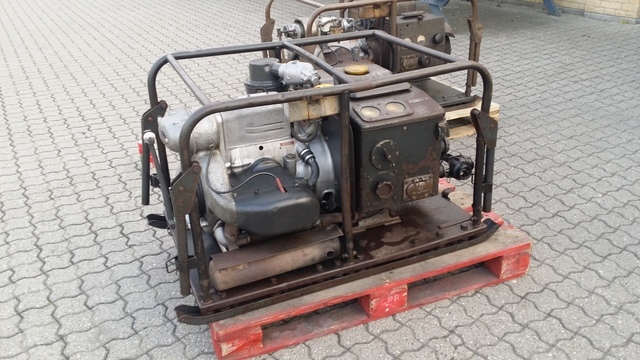
Another post from Denmark Previously I showed you my WW2 Zündapp KS600 generating set and now I'm back. It's time to present my Auto Union GG400 generating set, nicknamed "Panzerwürfel" - Würfel being a cube. Most of these sets (and mine too) supplies 12V and 16V, depending of if you need it to supply power to the radios or if you are charging the batteries. All german armed vehicles had one on board, allowing them to be parked in the battlefield with power to the radios without the main engine running. It's a very compact unit but still features electric start per push button, when connected to a battery. Mine as an early model, which were less robust and prone to cracking the engine mount and mine were defective as well. Dating is easy, as the crank is dated (I just love the effectiveness of the germans). Like much of my stuff I have absolutely no use for it, but it is so nice to have . Enjoy! /Steen
- 1 reply
-
- 1
-

-
-
-
-
-
-
-
Greetings from Denmark, I think we need more german stuff here . I have this portable (well - 305 kilos, no wheels) generator as used by the german forces in WW2. They were built from 1940 well into the 1950's. This particular one is from 1944, which can be seen from many details made from steel, which, on the earlier versions were made from aluminium. The generator set delivers 7,5kW on three phases. The engine is a 600cc Zündapp boxer, which makes it very smooth even at full load. This one is fully functional, but most have defective generators these days. /Steen Markings
- 1 reply
-
- 3
-
-
-
-
-
-
-
-
-
-
I have used either the kitchen stove or a hot-air gun. Mostly depending on for how long the missus leave the house ;-) . From experience I can tell though that if you forget it on the stove, it can be kind of hard getting the smell out of the house before she returns... /Steen
-
I cleaned my tank by heating it op on the stove and pressed the bottom plate out, when the (epoxy?) glue got soft from the heat. Easy actually. After cleaning I glued the plate back in using epoxy-based tank liner. I didn't line the tank - just used the liner as glue. /Steen
-

unknown knapsack sprayer & rotavator
Twinsport replied to Jarrovian's topic in Pedestrian Operated Machines
Nice finds! Isn't the engine on the rotavator an Aspera engine? I seem to remember them from my childhood as quite temperamental ;-) /Steen -
Hi there, Having worked with RC-engines for many years and having converted a couple from glow to diesel and the other way, I would consider converting an O&R engine pretty straight forward. My biggest concern would be the roller bearings that are pretty tiny as they are and they will see much heavier load when running with the higher compression ratio. And then we have to see if the fuel lines and the diaphram in the carburettor is able to withstand Ether. It's an interesting project, but I wouldn't expect such an engine to have many hours in it ;-) /Steen
-
-
Greetings! I have used sodablasting for years. It's a mess and I have found that the price for having it done by a company equals the cost of materials. I think the greatest advantage is that since the soda is not reused, the parts that go for blasting is not required to be cleaned first. The soda does leave the aluminium with a matt, dull surface so I usually clean the parts with a pressure washer, dry them and blast them with aluminium grit. Cast parts gets a very nice surface from that. A surface that is very close to what it may have looked like when new. An example of this is the valve covers from My Zündapp: /Steen
-
-
-
Got myself a Tiny Tiger. Now need gaskets, seals etc.
Twinsport replied to Twinsport's topic in Ohlsson and Rice
It's alive! I couldn't wait any longer. Gave it a dose of Alkylate fuel with 5% Castrol TTS (for the good smell). It fired right up after priming, but needed a few seconds to clear itself and stop running rich. I also tested the output which works perfectly, although not as powerful as indicated on the generator. It might deliver 300W at 110V, but at 12V it doesn't get near the indicated 12A. At 10A the output goes below 12V and if you load it even more the output just breaks down. Never mind that. I am smiling now, but my ears are hurting. Are these things loud or what! /Steen -
-
Got myself a Tiny Tiger. Now need gaskets, seals etc.
Twinsport replied to Twinsport's topic in Ohlsson and Rice
That is very generous of you! I would like to take you up on that, but before we go ahead, I need to check my own tank first. We know the visual state of it, but I have to make sure that it holds fuel and I also have to take more photo's of the tank up close, so you know exactly what you get. It will take me another week or so, but I will get back to you asap :-) /Steen -
Got myself a Tiny Tiger. Now need gaskets, seals etc.
Twinsport replied to Twinsport's topic in Ohlsson and Rice
Hello again, Got the tank welded the other day. I have tried welding some pretty horrible alloys during the years, but this one takes the price! The cracks in the tank was worse than expected, so it ended up in four pieces. The entire mounting lug broke of in three pieces, so it wasn't to easy to piece it together. While it may not be pretty, it's now in one piece again. I coated the inside of the welding using epoxy, so now I'm just waiting a week or so to let it cure. It's now looking like this: I think it looks quite decent now, but if any of you guys have a spare tank lying around, just let me know. I would like to get rid of that welding if I can. /Steen -
Got myself a Tiny Tiger. Now need gaskets, seals etc.
Twinsport replied to Twinsport's topic in Ohlsson and Rice
Ahh! Got it! My reed petals are steel (possibly stainless), so likely still not a late unit. Got round to finishing the assembly of the generator itself last night, So now only the tank needs welding. I'm curiuos to find out if I can weld this alloy? Did anybody here try welding anything on these engines? /Steen -
Got myself a Tiny Tiger. Now need gaskets, seals etc.
Twinsport replied to Twinsport's topic in Ohlsson and Rice
Thanks for the informations. It might be 1963, as the reed block is aluminium, not plastic. Anyhow - I took it appart for a bit of cleaning, and while it is not NOS, it have not seen much use. There is no carbon anywhere: I ended up taking it totally apart and gave it a good rinse. This is the state now: The air filter was falling apart, so the foam is now removed and one of the insulating washes on the 12V outlet was cracked, so while waiting for one of my friends to find hos box of these washers, this is as far as I got. /Steen -
Chaps! Most toilet cleaning fluids here in Denmark contains acid. Some also contain bleach. The acids used are either phosphoric acid, citric acid or hydrochloric acid. I avoid the two latter acids (and bleach). While phosphoric acid is as effective as the other acids, it is far less aggressive to aluminium. I Never use caustic soda. I find it far to aggressive. Both to aluminium and to my skin.. /Steen
-
Yep - the acid in the toilet cleaner also removes serface rust. It's nice, isn't it? :-) /Steen
-
Got myself a Tiny Tiger. Now need gaskets, seals etc.
Twinsport replied to Twinsport's topic in Ohlsson and Rice
Wow David - that's a beauty! I actually took of the cylinder yesterday only to discover that the engine is totally clean inside. No traces of carbon anywhere. Not even the slightest in the exhaust ports, so I am sure that the condition is decent. Maybe a full cleanup and a new diaphram is enough to get it running. Who knows? But boy - are those piston rings thin or what? I noticed that your crankcase is only fastened by three screws. So is mine, but is that normal? /Steen