| |
-
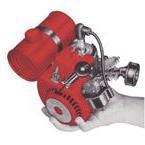
Just remembered I took a couple of pictures last time I made some new flywheel keys.
It was made from an aluminium rod that was the closest in diameter to the original key.
A disc was turned to the same thickness as the slot in the crankshaft, the disc was then parted off & cut into two halves. A small piece of U section plastic (cut from a document binder strip) was used to hold the half disc for filing the height to fit the flywheel & crankshaft.
Webhead's method for making the key from aluminium sheet stock sounds perfect if you don't have a lathe.
David
-
There are two types of flywheel key, the early engines had a steel key and the later a aluminium key (which is slightly smaller), if your Tiny Tiger is the one in the linked thread below. you will need the aluminium key. I would suggest asking Wallfish or Webhead on here for one.
If they don't have any, it is possible to make them if you have access to a small lathe, I have made a few for my engines as well as a special in-between size for fitting later flywheels to early engines (I had to do this as early starter dogs are not available).
I don't know of anywhere that sells modern keys of the correct size & material.
I did suggest making a handle in that thread, do you need the measurements?
The only way to get an original would be from another Tiny Tiger, as I don't know of any source for NOS spares for the generator.
There is a thread created by Wallfish showing how to take the Tiny Tiger generator apart for restoration or repairs, link below;
David
-
The Pittsburgh Press newspaper from the 30th December 1962 also seems to suggest the internal batteries were used in some way for starting;
"Device weighs only 14 pounds advertised as the world's smallest power plant is the 14-pound 110-120 volt unit introduced by the Creme Lure Co - Box 3379- Akron. The Power-Pack portable will operate four hours at full load on four pints of regular gasoline with outboard motor oil. Lights 250 watts (5-50 watt bulbs or equivalent) continuously. Besides providing light in out of the way places, it can be used for pistol drills, portable electric tools and electric razors. It's ideal for fishermen, hunters, campers, emergency light for homes, fallout shelters, civil defense, etc. The engine is an Ohlsson and Rice compact, two stroke cycle, 6300 RPM. Ignition regular flashlight batteries for easy start; magneto to run. Small built-in pilot light for refueling and starting in the dark."
David
-
I suspect the engine on the ebay one has been replaced at some point in the past, as the serial number on the generator is very close to the number on mine, but the engine is quite a bit newer. It also looks to have not been used very much.
My collection has a pump and a different generator, both with black starters.
Is it my imagination or did I see a blue version of the Creme Lure generator on the previous forum?
David
-
I saw the triple stack picture and thought it was perfect for fools day.
No fools now, here is my scan (second attempt) of the Perry Aquabug Owner's manual, the quality isn't great as the original was only a small book (pages 4" by 5.1") but it's better than nothing.
Perry Aquabug Owner's Manual.pdf
David
-
If the exhaust collector will not move, the cylinder will need to be unscrewed. But make sure the piston is free to move before trying this, as the con-rod will break if the piston is stuck.
The engine maintenance manual gives details on making a cylinder removal tool.
The instructions given are to make it from a piece of flat steel 3/16" thick & 1" square, with a hole drilled in the middle for using a screwdriver as a "T" handle.
I made one from a piece of steel & bar found in a box of offcuts & salvaged bits in the shed. I didn't bother to make it 1" square though, I only squared up the ends and drilled the hole for the bar.
If the cylinder is very tight I usually use a vice to hold the engine crankcase (use wood or similar to protect the engine from the vice jaws) and use an adjustable spanner to turn the tool. You will probably need to replace the gaskets if you remove the cylinder to prevent leaks. Also make sure that the slot in the top of the cylinder lines up with the crankshaft or is at 90 degrees to the crankshaft when reassembling.
Here is a picture of the cylinder removal tool I made.
David
-
Warn Industries are still going and they found adverts for the Warn winch model 800G & 800GW in their archives, see link below;
https://www.warn.com/blog/2012/04/24/vintage_product_warn_800g_gasoline_winch.shtml
David
-
I wish the Nichols was mine, it's the only one I've seen, the pictures were saved from an old ebay listing about 2 years ago. The Creme Lure in the first two posts is mine though, I have never run mine either and will probably not run it due to the design flaws of it being made from fragile plastic.
The only info for the use of the batteries is mentioned in the article linked in post 4, where it says "you start it on a built-in battery, then switch to magneto once it's running ".
I repair electrical & electronic items including motor control stuff for a living and I can't understand how it's even possible to start the engine with the AC alternator generator using 3 volts DC from the internal batteries.
There was a thread discussing this on the old forum where usedtoolman had tried using a battery and it didn't work for starting the engine (it's not clear whether it was tested with an external battery connected to the DC output or the 2 internal batteries), link from the internet archive below;
https://web.archive.org/web/20130814212024/http://ohlssonandrice.forumer.com/creme-lure-generator-question-t1187502.htm
David
-
The Nichols generator was featured in the Jan 1963 edition of Popular Science magazine;
https://books.google.co.uk/books?id=myADAAAAMBAJ&pg=PA157#v=onepage&q&f=false
Both the Nichols & Creme Lure generators had 110V AC outputs as standard, some also have 6V & 12V DC outputs as well. According to the article linked above, the batteries inside were used for starting.
David
-
This generator was also sold by Nichols Ind. Inc. of Jacksonville, Texas.
Here are a couple of pictures I archived from ebay.
David
-
And some pictures of the horrors inside, this is a good reminder not to leave batteries in items that are not being used, the nine lives have clearly been used up with these vintage examples that were found in mine! I had to do some dismantling to remove them.
Also note that the generator coils can become loose, which will result in the them being damaged if the generator is run.
David
-
Thought I should start a thread for the Creme Lure generator, as we don't seem to have one.
Here are a couple of pictures of the generator in my collection, it's a "super portable power pack" model S made by the Creme Lure Company of Tyler, Texas & Akron, Ohio.
Most of these generators haven't aged well due to the frame/covers and gas tank being made from plastic, the gas tanks are often warped & the covers can crack.
David
-
You got me, it was indeed an April Fools.
I do wonder if engines could be linked together though.
The picture is actually a diagram showing the Aquabug being raised or lowered for shallow water operation, from my Perry Aquabug owner's manual. The book does lie about the power of the O&R, it claims it's 1.2HP, not sure I believe that the carb was electronically setup at the factory either.
The full manual will be added when I've scanned it all and created a pdf.
David
-
I have one of the Polaris Power Pole power-heads, still in it's box. But I don't think I will ever find any of the attachments to go with it.
Both the Snow Blower and the Power-Head were featured in Popular Mechanics magazine, the Snow Blower is in the December 1964 edition here; https://books.google.co.uk/books?id=SOMDAAAAMBAJ&pg=PA24#v=onepage&q&f=false
The article mentions they were planning 11 other attachments including a lawn mower, grass trimmer, generator, sickle mower and the outboard motor (Power Oar). I wonder how many they actually made.
And a Power Auger for ice is featured in the Jan 1965 edition here; https://books.google.co.uk/books?id=ReMDAAAAMBAJ&pg=PA130#v=onepage&q&f=false
A few other attachments are mentioned on page 222 including a hedge clipper and pump.
David
-
Talking of surprises, I found this special triple engined Aquabug when doing some research this week, it's rated at 4HP, has anyone got one?
David
-
I've finally identified one of the mystery tools from the first post, the engine with the blue frame & guard with a K in it.
It's a Krestronics KGC-3 Charge-A-Lite generator, same outputs as a Tiny Tiger but with a belt driven generator. The article below is from the Popular Science March 1962 edition, which is available online here; https://books.google.co.uk/books?id=OyEDAAAAMBAJ&pg=PA172#v=onepage&q&f=false
I'm guessing it wasn't as popular as the direct drive generators like the Tiny Tiger or Amp-Champ as no complete generator has been found yet.
There is a much bigger article on this generator in the Popular Mechanics April 1962 edition, the pictures look like a prototype version of it though. Available here; https://books.google.co.uk/books?id=F-EDAAAAMBAJ&pg=PA128#v=onepage&q&f=false
David
-
I've been doing a bit of research and have found an early article on O&R engines including some of the first tools available, some of which probably didn't sell very well.
The full article in Popular Science magazine June 1961 edition is available on google books, it starts on pages 64 to 67 & the rest is on pages 208 & 209; https://books.google.co.uk/books?id=ASYDAAAAMBAJ&pg=PA64onepage&q&f=false#v=onepage&q&f=false
Here are some of the tools I've never seen before, including a gold separator, a different bike engine kit, a light aircraft tractor, a different design of compressor, a small mower and the smoke jumper (not sure it would have been very effective with that tiny water tank). I'm going to need a bigger shed if I find any of them.
There are a few more O&R articles in both Popular Science and Popular Mechanics magazines available on google books if you look through the 1960's & 1970's issues linked below.
Popular Science;
https://www.google.co.uk/search?tbo=p&tbm=bks&q=ohlsson+rice&tbs=,bkt:m,bkms:1168684103302644796
Popular Mechanics;
https://www.google.co.uk/search?tbo=p&tbm=bks&q=ohlsson+rice&tbs=,bkt:m,bkms:1168684103302643961
The May 1972 edition of Popular Mechanics has an article on a minibike with an O&R engine that was converted run on steam power, has anyone come across a steam powered O&R before? Looks quite dangerous.
https://books.google.co.uk/books?id=StQDAAAAMBAJ&pg=PA21#v=onepage&q&f=false
David
-
Send a PM (private message) to either Webhead or Wallfish to ask about parts, if you need help with anything else other than carb problems with your chainsaw it would be best to start a new thread about it.
David
-
Webhead and Wallfish on here have spare parts for these engines as well as the new diaphragms for the carb.
David
-
Good advice on the plastic fuel tanks.
This is the the other one I have, is the cover beyond repair?
Here is a picture of the Perry Aquabug label on the better one of the two, I seem to have lost the "supplied by Perry's yacht centre" sticker (maybe it fell off before I got it).
They were imported by R Perry & Company Limited of Monks Ferry Works, 90 Church Street in Birkenhead, I've looked it up on Streetview but it looks like they are long gone.
David
-
Welcome to the forum, your Aquabug looks in nice condition, I have a pair of them rebranded by Perry in the UK, both the plastic covers are in poor condition.
There are quite a few joins in the fuel line, the clear tubing can become brittle and crack, also one of mine has a hole in the plastic fuel tank.
David
-
No, it was in Florida, I do look on the US site occasionally.
I have also seen two O&R's in Germany in the past, but I don't look there very often, one bare engine and the other was a Little Wonder hedge trimmer.
David
-
Another unknown make O&R tool found in the completed listings search on ePay, It has a reduction gearbox driving a pump described as possibly being hydraulic.
David
-
Seems it sold very quickly as a buy it now, after the auction ended.
http://www.ebay.com/itm/p2047675.l2557
David
-
Definitely looks like a custom made exhaust, the cylinder cooling baffles/plates & the magneto plate have been modified to allow the exhaust to fit.
David
|
|