| |
-
Can you post a picture of the spring in question to confirm the governor version fitted to the carb and I can assist.
David
-
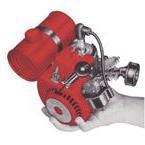
This arrived a couple of weeks ago, a fairly early 1960's type 98 engine, the paint colour is original as far as I can tell, I haven't seen another in this unusual colour.
If anyone knows what tool it may have been used for please let me know.
The tank bracket & strap needed a bit of adjustment and some screws, now reassembled.
David
-
I found an interesting document last night from 1974 that features the Turbair sprayers archived on the UK Forestry Commission website;
https://www.forestry.gov.uk/pdf/FCBU048.pdf/$FILE/FCBU048.pdf
The Turbair Tot 2S cost £59.50 in 1974, see page 92 for the range they offered then & the prices, page 182 for a picture of someone without any suitable PPE for using it and page 215 for a similar picture with a wheeled version (not sure if it's a O&R powered one).
The article seems to imply that Micron Sprayers (Edward Bals) of Bromyard and Turbair Ltd (Pan Britannica Industries Ltd) of Waltham Cross are separate companies, both companies of course sold the O&R powered Turbair.
David
-
Not seen anything exactly like that, but it could be a home-build reduction drive unit for a mini-bike, similar to this idea for building the Tom Thumb mini-bike (article from Popular Mechanics Jan 1970 edition);
David
-
It seems Edward Bals (Sprayers) Limited of Bromyard, Herefordshire, one of the companies that originally sold the Turbair sprayers are still going, they are now known as Micron and they still sell the battery & mains electric powered versions of this sprayer (now known as the Electrafan).
The bottle supplied with the new sprayers looks a little different to the originals, but they should be able to advise if it would fit the older sprayers and if they are available as a spare part.
Check the website linked below for the modern instructions (which have some exploded diagrams that may help, even though they are for the electric versions) if you are intending to use your Turbair, obviously a lot more PPE is recommended these days.
http://www.microngroup.com/electrafan
David
-
Hi Mark
I scanned & uploaded a pdf of the instruction manual for the Turbair Tot 2S last year to the thread linked below;
There is no exploded diagram for the sprayer in the manual, but it does have the general maintenance instructions which mention checking the contact breaker points, other things to check if the points are clean & set correctly include; the switch is on & not shorting out, the condenser, the magneto leads & coil.
If your Turbair has the 14mm thread in the cylinder head, the spark-plug that was originally fitted would have been the Champion CJ8, these are still available at a reasonable price. The most commonly fitted alternate spark-plug I've found for the CJ8 is the NGK BM6A, the site linked below also has useful cross referencing information for the spark-plugs, check the length of the thread is short reach if buying an alternate.
http://www.gsparkplug.com/1x-champion-standard-spark-plug-cj8.html?___SID=U
If the spark-plug thread is 10mm the Champion UY6 would have been fitted, these are also still available but are more expensive, but I haven't seen a Turbair with an early enough O&R engine for this spark-plug.
Exploded diagrams are available for the engine if needed (I don't have the exact one for the type 186 engines that are fitted to mine but have many similar), as well as the sticky threads with pictures for rebuilding the carb and engine.
Usually the carb diaphragm needs changing to get the engine to run well, also don't forget to change/remove the filter foam in the air filter as the old stuff crumbles to dust and will cause damage if it gets sucked into the engine.
I don't know of any source for suitable bottles to fit these sprayers, it seems most people don't want to sell them with the sprayer due to the hazardous chemicals they contain or once contained. I sent the only spare I had to Wallfish to complete his Turbair.
David
-
All the pictures I have seen of various Turbair sprayers have the idle screw (with the spring missing) tightened all the way up jamming the governor as I mentioned before. I did question the missing spring when this latest one arrived, but it isn't used on the Turbair as far as I can tell.
*Note the following does not apply for the Turbair engine;
Normally the carb idle stop screw (fitted with a spring) is used to adjust the idling speed, the lower holes below that are used for a throttle cable (held with a clip) on tools/applications that use a remote throttle control, eg. the bike kit or outboard motor.
David
-
This arrived on Friday to join my collection, a very nice barely used Turbair Tot 2S.
I also spotted something I hadn't noticed before with the Turbair sprayers, the carb idle adjustment screw (without the spring) is used to jam the governor vane & keep the throttle open, which will keep the engine running at an ungoverned maximum speed. Here is a picture from the manual showing this, I haven't found any references in the manual as to why they did this though.
And a picture of this on the Turbair.
I have also checked my other two Turbairs and they are both the same, as are the ones I have saved pictures of in my archive.
David
-
I was also asked about the carb type for this saw.
The carb fitted to my Challenger saw is a Walbro HDC6.
Note that the model 20A maintenance manual has an error, as the carb has a right angle fuel inlet and the manual shows an incorrect carb model no. below the picture.
Here are some pictures that I posted on the Ford Eagle saw thread a couple of years ago.
David
-
I was contacted by revmix earlier this week by PM for information on the Magneto coil & condenser type fitted to this saw, I thought it would be a good idea to add the information here too.
A quick look at my 1977 ESA service guide gives the following O&R part numbers;
Coil with core & leads 400010, coil only 400305/400350
Condenser 400293
The O&R model 20A-256 parts diagram lists the condenser as 200110 & coil assembly 400010.
I believe the ignition parts for the Model 20A engine were made by Wico, so new standard pattern parts may fit. The coil in mine has the Wico part no. X18086, but I get no results searching for that number.
The model 20A-256 parts diagram, model 20A engine maintenance manual & Challenger maintenance manual can all be found on this thread;
David
-
It's a task I had been putting off for a while, as I have some spare later bearings (possibly NOS but without the packaging and all mixed together) I needed to identify and I also wanted to work out what I may need for restoring some of the other early engines & tools in my collection.
David
-
I've been checking some if some of the steel caged bearings can be fitted to the older engines that used the plastic caged bearings, using the crankcase from the incomplete parts engine (s/n 044706) that donated some bearings for the Tiny Tiger Model 400 restoration.
Here is the outer crankshaft (flywheel side) bearing (part A-27-3), the steel caged type fits fine.
Note the service manual states that the closed end of the cage should face outwards, as I didn't want the rollers to escape when removing it I put it in the wrong way up.
Here is the inner crankshaft (main) bearing (part A-27-4), as I don't have any of the double steel caged bearings in my spares, I used the only two single ones I have for this check, they also fit OK.
At this point I noticed the larger plastic bearing cages from the Tiny Tiger 400 have shrunk making them a force fit, not good for a bearing at all!!
I can't check possible replacement part A-27-17 as I don't have any.
Here are the back shaft (PTO) bearings (part A-27-2), two sets of these are used but I have only pictured one set.
They do fit, but could benefit from the burrs being removed before use.
Note the slight difference in thickness of the steel caged ones (I'm not sure if my spares are the single types intended for use in the gearboxes as the rollers are not in them).
I can't check possible replacement part A-27-18 as I don't have any.
This leaves the con-rod (big end) bearing, unfortunately I don't have any of either the plastic or steel caged (part A-27-11) or washer retained (part A-20-5-13-7 ??) bearing types to check this one.
I suspect the missing bearing from this crankcase was the steel washer retained type, as one washer is still in place.
Here are a couple of pictures of the con-rod (big end) bearing in a different 3/4HP engine (s/n 074258), I only took the induction/PTO housing off this one (they also have the plastic caged bearings fitted). The con-rod bearing is the steel washer retained type, could this be part A-20-5-13-7 ??
I hope this can help with identifying suitable replacement bearings for your engine.
David
-
I remembered that the pile-o-bits Tiny Tiger I restored came with a couple of NOS bearings, mostly of the wrong type for it.
Here is the crankshaft (flywheel side) bearing part number A-27-3, the rollers are not with it as the packet had been opened, this isn't the first time I've come across an updated part with the same part number as the original part.
I should point out that the steel bearing cage is very slightly thicker than the plastic version, here are the two together.
Here is part number A-27-1, this was incorrectly ordered by a previous owner of the Tiny Tiger, this bearing was only used in the first 6000 (approx) engines produced. It is also used in gearboxes for all the 3/4HP, 0.85HP & 1HP engines.
David
-
Hi Alberto
Maybe he has a full message inbox?
David
-
Hi Alberto
Click on the envelope symbol next to your username at the top right of the page to start a PM, or hover the mouse cursor over Webhead's name in post two & click the message option.
David
-
Didn't need to take anything apart, all the information needed was in the various parts diagrams & manuals I have.
The bearing assemblies used in the 3/4 HP early engines dating from 1961 (after s/n 006072) to Dec 1963 are;
A-27-2 (2 sets) used for both back-shaft (PTO) bearings, can be replaced with A-27-18 according to the 1971 price list.
A-27-3 used for crankshaft outer (flywheel side) bearing, part number stays the same after 1964 & 1965 for steel caged version.
A-27-4 used for crankshaft inner (main) bearing, can be replaced with A-27-17 according to the 1971 price list.
A-27-11 used for con-rod big end bearing, can be replaced with A-20-5-13-7 according to the 1971 price list.
I would be interested in seeing pictures of NOS steel versions of A-27-2, A-27-4, & A-27-11 as well as the later replacements A-27-17, A-27-18 & A-20-5-13-7.
Send a PM to Webhead to see if he has any of the bearings needed to replace the damaged ones, as well as a replacement carb diaphragm. I will enquire to see if he has any spares remaining afterwards.
David
-
From the pictures that you have posted, I can tell that your engine is an earlier production 3/4HP one (Mods please correct the title) as it has plastic bearing cages for all the bearings & the metal reed valve, it will have been made before October 1963.
Oddly the carb has the updated quadrant speed control but not the primer button (maybe the bottom half of the carb has been replaced at some point).
See the NIAE report from 1964 for more information on some of the problems they had with these earlier O&R engines & design changes introduced then. I have recently added a PDF of the report to the thread here;
The last couple of O&R engines I have rebuilt have also been earlier ones with the plastic bearing cages. As they are much harder to find replacement parts for, I reused the bearing cages with no cracks and had to borrow some from an incomplete parts engine of similar age (which I also discovered someone had previously robbed the con-rod bearings & cages from) to complete the restoration.
I really need to identify and dismantle a 1964 engine to find out if the updated steel caged bearings can be used for the earlier engines, as I have quite a lot of them in my collection. I do know they increased the size of the crankshaft main bearing at some point in the later 1HP compact III engines.
David
-
I'm a little confused too, are you missing a bearing or do you what to replace a damaged one?
There are several different bearings used for the crankshaft, PTO shaft, con-rod & gearbox (if fitted) and different sizes with the various design changes made to these engines over the years.
Some pictures may help identify which bearing you need.
David
-
Having found a leaflet for a CARBRA hedge cutter that looks very similar to mine (apart from the engine), I no longer think this hedge trimmer was made by O&R. I now suspect someone has adapted it to use the O&R model 20A engine, the fuel tank fitted is from a Cox series 140 engine, same as on the engine shown on the sales leaflet.
The series 140 engine was made by O&R competitor Cox, the series 140 engine was also used on a chainsaw & bike kit and was also produced by Roper after they bought the rights to make it.
Here is the rest of the CARBRA hedge cutter leaflet scanned & converted to a pdf;
CARBRA Hedge Cutters .pdf
David
-
Did they have an on-line catalogue? I couldn't see any links to one, but I have just found more pictures (probably too late) here;
https://imanauction.com/cox-collection-iac-12.1.html
The lots included; two Tiny Tigers (one with replacement later style starter housing), a Chicken Power bike kit and a Meier Line chainsaw, they all look unrestored. Pictures attached below as they will probably disappear eventually.
David
-
I noticed a while ago that the scanned pictures of the NIAE test report in the first post had reduced in size and as I now have an original copy of the test report, I have created a pdf from it;
NIAE Test Report Ohlsson & Rice Model J Engine Published Feb 1964.pdf
The NIAE tested a couple of O&R's between Jan-May 1963 & published a report in Feb 1964.
They originally intended to run the engine for 100 hours to determine the suitably for agricultural use & the maintenance requirements, they concluded that the early engines tested were only suitable for intermittent use.
The first serial number tested was 030957 (model J), it had problems with the die-cast gears being very badly worn, they got through two sets of gears during a 31 hour test & the first set of gears jammed up due to a broken tooth, the cork clutch lining material was also worn.
They did tests on a couple more engines (model letters not stated);
s/n 030987 with gearbox, this also failed with a broken gear tooth after 20 hours.
s/n 030987 with direct drive taken from s/n 030993, test abandoned as the PTO shaft wouldn't stay tight on the taper.
s/n 053595 with drive through clutch, this was the longest test (50 hours), it mostly only had minor problems.
O&R stated that the NIAE test was inappropriate for this engine, which would have been more realistically tested in complete equipment with normal operation times & intervals. They also made some design changes between Oct & Dec 1963, these included;
an improved clutch & steel gears (were die-cast).
more needle roller bearings with steel cages (were plastic).
bigger exhaust ports.
plastic reed valve (was metal).
primer button on carb (a kit was available to update earlier engines).
governor vane modification.
fuel/oil mix changed to 24:1 (32:1 now recommended with modern oils).
quadrant speed control on carb.
The U.S. Department of Agriculture tested the direct drive Paradox pump in May 1964 and managed a 99 hour test with only a failed coil & a new set of piston rings being required. General maintenance included a couple of replacement spark-plugs and de-carbonising of the exhaust ports after 25 to 35 hours of continuous operation. See the previous post for a link to this report.
David
-
Found an air cleaner/filter on ePay, the seller thinks it's a muffler, which the pictured part isn't;
https://www.ebay.com/itm/Orline-M123-Chainsaw-OEM-Muffler-/151587552778?rmvSB=true
It doesn't come with the fixing screw, but that would probably be attached to the chainsaw carb it was removed from, as the later air cleaner screw was riveted to the carb.
They also have the muffler advertised as an air filter.
David
-
I would be interested in seeing the instruction manual, are you able to scan & add it as a PDF? A forum update a while ago lowered the maximum resolution of pictures on here, any manuals posted this way are pretty much unreadable now. I think most manuals I've scanned & posted on here are PDF's, which are unaffected.
O&R changed name to Advanced Engine Products sometime around the mid 1970's, tools with the renamed AEP engine were still being advertised until around 1978, but I haven't found anything later than this yet.
The shark 60 uses .60 model engines, seems the O&R powered helicopters were discontinued, but they offered conversion kits for the Hughes 300 & Shark to use .60 engines, see the advert below from this website; http://www.vrhc.co.uk/rc helicopters/USA/Du-Bro/Du-Bro.htm
David
-
The serial number dating information from the "small engine service manual" is only relevant for engines made after June 1967, before this they used a sequential numbering system, we can only estimate the dates for these engines based on information from original documentation.
The NIAE tested four engines with serial numbers ranging from 030957 to 053595 between Jan-May 1963, with this information both of your engines should actually date from around late 1962 to early 1963.
David
-
Click on the envelope symbol next to your user name at the top right of the page for sending a PM.
Webhead should have the carb diaphragms & check valve, but probably not the air filter assembly, which is one of the most commonly missing parts and replacements are very hard to find.
David
|
|