| |
-
Hello Steve,
Your engine is a 1987 model. A bit past my B&S workshop manual date of 1982, but I've added a link here- B&S 132922 (and hope it works ok)
It provides you with a Parts List for that model. Can't see a spring amongst the relevant items.
Hopefully,, Wristpin will be along at some point and enlighten us.
Rgds
Edit - Sorry can't get link to work to your engine, but suggest you follow B&S site directions to your model number
-
Ok Norm. Looks like your habit is no longer in remission ! . Still , it will keep you occupied getting it the way you want it.
Regards
-
Thanks for the pics Norm. Well laid out garden with interesting implements. Imagine a 'Forth Bridge Painting' regime to keep them all fresh looking like that.
-
Very nice work Toma, I'm impressed. I like the extra fuel can stowage idea/design. I'm sure it drives a well as it looks.
-
Bumped his topic as I had to make more improvements to it's condition. Plus I need to excercise the hands caused by R/Arthritis, so glad to get back into the workshop.
The spindle/chuck mounting bodge of a cut off piece of bolt shown in earlier pics was just not good enough.
I made a new complete spindle from 3/4" (19.05mm) dia silver steel. Set up in the lathe and acurate to within 2 ten thousandths of an inch (0.00508mm) over it's length.
Pic below is after machining the chuck thread on the end-
Comparision of the old and newly machined spindle ends-
After measuring, I found I could reduce the length of the 3/16" (4.75mm) wide cut slot for the new one, which produces a better bearing surface. the chuck thread for the English made Jacobs chuck is 1/2" x 20 tpi UNF, and the smaller diameter top end threaded 3/8" Whitworth. Both were screwcut on the lathe (my 1st attempt at power feed screwcutting)-
Did a check with a 5/16" (7.95mm) diameter long Dowel Pin fitted in the chuck while still on the lathe and it had only 0.0015" (0.038mm) runout at 1.5 inches (38mm) from the chuck jaws!, so pretty good allowing for the age of the chuck.
Did the same after fitting back into the drill and adjusting lower bearing clearance, I got 0.003" deflection while applying a side load, so I am more than happy now with it's condition.
Regards
-
Made up a holder for it so it can be stowed out of the way-
Job done.
-
Thought I'd add another find to this old Topic. Acquired another pressure feed 'Oiler' for a 'Fiver' (uk£5.) It was amongst a box of bits from a shed clearance. It was in a bit of mess, seized and badly beaten-
Initial clean up to see what I had revealed it was another Lucas Oiler from the 1920s. Diameter is 1. 1/2" (38mm) to give you an idea of size. All I could do was bite the bullet and desolder it all and reduce to constituant parts and see if I could clean it out and repair it back to working order. After a few days work, I had reduced it to this-
I managed to remove some serious dents to improve appearance, but will always have the scars of use/misuse to show it's age.
I had to overcome a problem with reassembly due to not being able to solder some internal joints and ensure they held in the right place and soldered/sealed together.
So I hard soldered some parts and so able to ensure it all went ok when 'Closing up' the 5 other soft soldered parts/joints all at the same time .
The bronze 3/8" dia ball is a replacement, as the original steel one looked more like a large lump of weld spatter. So I lapped the new one to it's seat for a good non-return seal.
New leather washers made for the plunger and filler-
As usual, the end cap and threaded section was missing, so I reproduced a nozzle and cap. The cap having a leather pad in it to seal it when screwed on.
After several flushes with acid, soapy water and dried out, it had the plunger sealing washer greased, piston oiled/primed and filled.
No leaks and can now deliver a single drop or stream under pressure at any angle. The fine nozzle can displace the small ball in oil nipples to lubricate, rather than have a cumbersome Grease gun type nozzle which is useless in confined places on machines.
So that's the Lucas Oiler No 36 given a new life and will have a copper 'Holster' to safely stow it on the Lathe or Mill in the workshop.
-
Can't ID it positively. It could have been imported. Monro Ltd imported/distrubuted SIMAR cultivator units from Switzerland initially, and then produced their own version of a Cultivator late 40s/early 50s.
Suggest you check the thread form on a bolt/nut to see it is Metric, Imperial or Unified (U.S) and may give you a clue. Not sure if they produced their own Seeders, but looks way 'over engineered' for post war UK to me, compared to other models I've seen.
Look's like it had a lid on the hopper initially due to the unfaded paint line on the front. Are you giving it the full treatment?.
-
Good to hear they let him out. Hopefully based on overall improvement and not on parole!!. Please pass on my regards when possible Alan.
Regards
-
Really hoping he pulls through this and able to get back on the W Horses very soon. please pass on my best wishes to him/family.
-
Well done Nigel. An awesome building/workshop to turn out your awesome projects in . As for condensation, looks like there is still a lot of moisture to remove before it's fully dry at this time of year.
Wish you many happy hours in it.
-
Wow!, That all reminds me of 17th Oct 1987 at this end of the country. Hope you get straight soon with the damage repairs.
-
Long time since I posted. Norm, yes. Although since i said that, my chances of actually making them is diminishing. The wrist joints are a real issue now and holding up my progress on many things.
Prioritising this project has now brought it to nearly finished stage. Last week, it took 2 days to mask off the rear wheel sides and strakes (treads) to etch prime/paint the faces of the rims-
Need to dull off the front rims next
With this back together on wheels, I finished making the alternative drawbar for the Water Cart so it can be 'hitched up'.
Trial fit to check levels-
Hoses and plumbing to do on this next.
Regards
-
Thought I'd just add an update, as it has been a while and only recently able to progress with this one.
It does not really fit in this forum section as a project. So just to say that I've got it nearly all back together.
When it is properly running, I'll add it to the 'Other Garden Machines' section
-
Hi Norm, Sorry, I did not intend to make it look like an advertisment for a sale on here. I'll drop you a message when I get sorted.
-
Nice job there! . .......I'll know who to ask about the JAP 2a if I have any probs with the one attached to a pile of rust that I've been asked to breathe mechanical life into.
-
Nice project/machine. Always wanted to get my hands on a Blackburne. Shaft driven magneto br looks of it?. I presume you have all the info you need by now?. Do you know the Mower's age yet?.
-
Hi Norm,
Not a good experience when it happens. Those forks are the 'Achillies Heel' of the WH trans, considering the rest of it is built like a Victorian brick WC.
At least the parts fit back together with a register for lining up again. Look's like there is a bit of wear around curved fork face as well
Hope the weld job works ok to save money and get it fixed.
I have the surplus C-120 8 speed trans sitting around and wondering if I could be bothered to put it on the Job List and open it up for an overhaul?.
Too much on the go, so may just sell it on with my stock of new roller bearings etc, just to make space.
-
Hi All,
I've been advised that Paul at Meetens (UK) is planning to cease trading for health reasons. Don't expect to receive an immediate response for new orders etc.
I, or someone hopefully will update this with any further news.
Also, those who are into Mower/Engine parts etc, I believe Jon Cruse of Hailsham is struggling with health issues and may have to cease trading, but need to confirm this.
Regards
-
.........If anything.........That was the issue I was asked to sort out recently. A heavy bronze carb fitted to a small water cooled 1/2hp engine from 1923 and had been adapted to fit onto an early 1930s Lawnmower!!.-
I actually found a Manual and parts list for the engine, but of course not one single available spare part. Failed to find anyone else online familiar with, or who had a similar ''N' type engine made by Stuart Turner.
Several bits missing according to the parts list diagram and one item had fortunately been acquired from ebay...the all important Float Bowl (screw on) Lid.
So I had to make and find the bits etc, so as it had not run for god knows how long, it was dismantled-
Certainly overdue for a clean and repair. The small clip under the spring (bottom middle of above pic) should be fixed by solder to the float. It holds the needle at correct height.........duly fixed.
Established that the large hollow brass nut (top left above) which acts as a sediment bowl should have a screened filter and a spring within. items (on left of next image) 4044/4045-
The bits had to fit within these parts-
So after a search for materials, a bit of lathe time and some soldering, I had the 'makins' of the necessaries-
The 'Stove Pipe' top hat filter body was silver soldered together, so that I could soft solder the mesh to the bottom and sides. But not before it was subjected to some careful milling to put some 1/4"wide slots into the side wall.
Appears to be some distortion in the image below which makes the filter body look crooked, but assure it is not.
-
I was lucky to find in my stock, a suitable spring to apply pressure to the filter and keep it all in contact with it's seat. That filter/sediment body nut is 1 inch A/F.
So all done and ready to bolt on. Now super clean inside and favoured the patina to polish on a motor of this age-
Oh and yes, I have the task of getting this thing running/working, along with another pile of broken rusty bits......I may be some time!.
Regards
-
Good to see you back postin Ian!. Should help to stem the flow of tumbleweed and the sound of howling wind across the forum.
Good work there. A much larger form of 4 way tool post than I have on my old myford, but they're sooo handy.
Keep 'em coming.
Regards
-
Hello Gents,
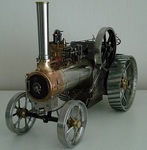
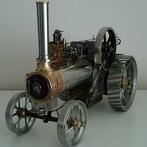
Thanks for viewing and your comments. A little more progress to date. The front end is more or less sorted ready for the chimney to go on and is now sitting on it's front wheels.
The cylinder in the original model design had a bland side face just shaped and usually painted black. I, as may be seen in a previous post, just had to make things more difficult for the sake of detail.
I made up a cover plate and secured it with screws as per the full size engines. This has been painted the same dark blue as other parts and (I think) helps to finish the area off.
I have just replaced the last temporary screw on the cylinder part for a stud/nut, but you will see a countersunk screw in the top Guide Bar in this pic which I had taken earlier.
The tiny (7mm dia) steel handwheel on the Blower Valve was drilled and finish filed by hand/eye, but looks ok I think.-
The steering chain drum finshed and now fitted is also modified from the model design to reflect full size layout. The chain (brass) is what used to be supplied to clockmakers for the winding system on long cases.
I plan too make my own at a later stage in steel with brazed links-
Lastly for now, I finished making the square headed blanking plugs and stop pins in bronze for the water pump and now fitted in it's partially hidden place down behind the rear wheel.
Original model design was for it to fit on the side of the boiler, which looks way out of scale, and over the years, other modellers have experienced priming issues when in steam with boiler mounted pumps.
I think it is because of the heat, but I fortunately redesigned this back in 1987 to locate in a cool area similar to full size layout-
Sorry about the last image quality, I deleted the wrong one . You may notice a red dot adjacent to gear tooth on both the 2nd and 3rd motion shaft gear wheels.
I have a slight resistance in rotation where these two coincide, so i think i must have a tiny burr on them, so i will pull these off and run them with some p600/oil & 'T' cut grinding paste to bed them in.
The running clearances were set using cigarette papers (about 0.0015"), so it doesn't take much to obstruct free movement. Hopefully more soon.
Regards.
-
After 2 months of poor weather conditions, I have managed to continue with painting and some assembly. I finally fitted the last of the valve covers on the cylinder block after setting all the valve event adjustments and finishing the motion work off to a standard of sewing machine smoothness. This allowed me to apply a penultimate semi matt black coat over all the joints, stud heads and nuts to consolidate the whole finish. The Chimney saddle and the exhaust pipe were painted separately, as the saddle is bolted, instead of the original model design of riveting. It is easier this way, as I can reach into awkward corners and touch in the bolt heads with the Airbrush on a fine setting.
Just need a little more care this way of fitting without paint damage. I detailed the exhaust a bit more with fitting a bolted flange at the cylinder end. The exhaust is 1/4" diameter pipe for clarity-
The Regulator Rod just under the safety valves in the next pic has a dummy tail rod and gland. I have to make the 2 x 14ba studs and nuts for it yet.
I decided to machine and file it from the excess metal on the casting to give it some detail, as the original model design just showed a lump of round metal there.
A bit of cleaning up of the overspray on the raised brass lettering to do, but otherwise a major step forward on the assembly front-
I did manage to get the top coat on the flywheel last month and very pleased with the finish. Only temporarily fitted, so the gib key pulls out easily-
Hopefully progress and updates will continue to speed up now, as the jobs on other projects are building up as well as work down at the museum.
I have managed to get some lathe time in though, helping out with making unobtainable parts for old mowers for a guy on the Old Lawnmower Club forum, so I have been busy really.
Regards.
-
Very nice project you have there. Good machines. The top cylinder condition is very familiar to me from past experiences (and current ones). Certainly better condition than the sort I get.
Keep to updates coming .
-
Sorry for the resurrection of this one, but thought those who watch Gardener's World (BBC uk) may see this mower (briefly) on this Friday's programme
It's included in Clive Gravett's (of the Budding Foundation Museum of Gardening) 2nd instalment on the programme covering the history of the mower.
It is also in the Atco Centenary Video on their website:- LINK within the 1950s period. So at least it's still earning it's keep with the Charity.
Regards.
Richard
|
|